What Is Consulting?
Consulting gives your small business added capability to work through security, risk, or technology efforts that require more time, expertise, and involvement than your team can easily provide on its own. It helps define the work, align the right people, and move toward a business goal with more clarity and support.
This often takes shape as initiative planning, gap remediation, program development, roadmap work, or other efforts that need more than internal coordination alone. Instead of leaving the work loosely defined or spread across competing priorities, consulting helps organize it into something that can be carried forward with purpose.
Consulting gives your business a clearer way to move from need to outcome. That means work is better defined, progress is easier to maintain, and the effort is more likely to deliver practical value once it is underway.
Our Approach
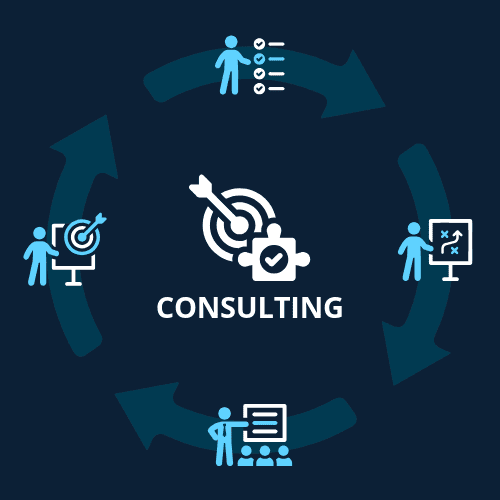
Results are achieved when consulting work is clearly defined, thoughtfully planned, and carried through in a practical way. ExaQuent uses this approach to keep work organized, expectations clear, and progress steady from start to finish. The outcome is work that stays focused on what it is meant to achieve.
Work starts by clearly defining what needs to be addressed, why it matters to your business, what the intended outcome should be, and where the effort begins and ends. This creates a much stronger foundation for the engagement and gives you a clearer understanding of what the work is meant to accomplish. It also helps prevent the effort from becoming vague, unfocused, or difficult to manage once it is underway.
Once the work is clearly defined, the next step is planning how it will move forward in a way your business can realistically support. Scope, priorities, timing, responsibilities, and expectations are organized so the effort has a clear path from the start. This gives you better visibility into what the work will require, helps reduce confusion before deeper execution begins, and makes it easier to carry the work forward.
With a clear plan in place, the focus shifts to carrying the work forward in a practical and organized way. Execution is about maintaining momentum, working through obstacles, and making sure progress does not stall when time, attention, or competing priorities get in the way. This helps keep the effort moving steadily so the work stays aligned to the intended outcome and does not lose direction as it advances.
The goal is to produce an outcome your business can actually use once the work is complete. Deliverables may differ based on the need, but the result should always be clear, usable, and tied to the reason the work started. Delivery is not just about finishing activity. It is about making sure the work leads to something practical that adds value and can be carried forward after the engagement ends.
Common Areas
Consulting can cover a broad range of areas across security, risk, and technology. These areas help define that coverage, showing where support may be needed before the work narrows into more specific needs, priorities, and outcomes.
Across security, consulting can help with identity and access, privacy, endpoint security, email security, network security, data protection, backup and recovery, incident response, vulnerability management, logging and monitoring, security awareness, policy development, security planning, phishing protection, patch management, configuration review, access reviews, privileged access, encryption, recovery testing, mobile security, threat detection, device management, security baselines, and more.

Across risk, consulting can help with business exposure, operational exposure, vendor exposure, third-party exposure, customer exposure, compliance exposure, technology exposure, change exposure, implementation failure, control failure, dependency failure, service interruption, business disruption, data loss, recovery gaps, incident fallout, misuse, fraud, liability, reputational impact, decision quality, audit pressure, contract pressure, insurance concerns, and more.
Across technology, consulting can help with platforms, systems, applications, infrastructure, integrations, networks, cloud services, business systems, productivity tools, collaboration tools, data systems, identity platforms, security tools, backup systems, monitoring tools, automation tools, vendor platforms, technical architecture, configurations, environments, documentation, migrations, system changes, tool alignment, service dependencies, implementation support, technical planning, platform oversight, AI, and more.
Common Needs
Consulting work often starts with a specific need that has to be organized, improved, or carried through. These needs reflect the kinds of efforts your business may need help shaping, supporting, and carrying through across security, risk, and technology. Unlike advisory, where conversations usually stay at a high level, consulting work becomes more detailed, more defined, and more involved as it progresses.
Turn your priorities into practical next steps
Your business may already know what matters most, but still need help turning those priorities into real work with structure, ownership, and a path toward completion.
Build a roadmap for the work ahead
Your business may need help turning broad needs into a clearer sequence of phases, priorities, and next steps so the work has direction and does not stay loosely defined.
Improve a process that is no longer working well
Your business may reach a point where an existing process creates friction, inconsistency, or gaps and needs to be reviewed, refined, and made more effective.
Create structure around a security plan
Your plan may already exist in pieces, but still need more organization, clearer priorities, a broader perspective, and a more practical path for carrying it forward.
Restart work that has lost momentum
Some efforts begin with good intent but stall over time. Consulting can help your business reestablish structure, clarify what still matters, and get the work moving again.
Support a major business or technology change
Larger changes can create work that crosses priorities, teams, or systems and needs more coordination, structure, and follow-through for your business to carry it through successfully.
Evaluate the impact of a vendor change.
A change in tools, providers, or supporting services may require your business to better understand the operational effect, the risk involved, and the right path forward.
Strengthen readiness before it is tested
Your business may need to prepare its work, processes, or supporting capabilities before a requirement, customer expectation, event, or operational need puts them under pressure.
Prepare for customer-driven requirements
Customer expectations can introduce new needs that require your business to plan, clarify, and complete practical work before responding with confidence.
Address gaps identified through an assessment
Findings from an assessment often point to work your business still needs to define, prioritize, and carry through before the result has real value.
Support implementation that needs more structure
Work may already be underway, but still need more structure, clearer sequencing, and stronger follow-through to carry it forward well.
Prepare for growth that changes the work
Growth can introduce new demands that change how work needs to be organized, supported, and carried through as the business moves forward.
value Gained
Clearer
Scope
Defined
Objectives
Faster
Delivery
Better
Execution
Deeper
Support
Practical
Outcomes
Engagement Options
Work can begin in different ways depending on how clearly the need is already defined, how much structure is needed up front, and how formal the engagement needs to be. ExaQuent uses these options to provide practical ways small businesses often begin consulting work.
Discovery Call
A starting conversation used to understand the need, gather context, and determine whether the work is a good fit for consulting.
Scoping Discussion
A more focused discussion used to clarify the work, define priorities, and shape the effort before it moves into a more formal engagement.
Project Proposal
A defined path used to outline scope, timing, effort, and cost when the work needs clearer structure before it formally begins
Direct Engagement
A faster path used when the need is already clear and the work can move directly into a defined consulting effort without delay.
Not Every Need Fits Consulting
Consulting is well suited for structured work, defined efforts, and support that carries the work through, but some needs require a different kind of engagement. When the work becomes more centered on ongoing guidance, less hands-on, or more focused on individual leadership development, another path may be a better fit.
Advisory
Guidance that helps you work through decisions with clearer direction and practical perspective.
Coaching
Focused guidance for those in leadership roles who want ongoing development, perspective, and support.
Start the Work with Confidence
Consulting helps small businesses turn defined needs into structured work with clearer scope, stronger execution, and practical outcomes. When you are ready to discuss the work, define the path forward, or explore whether consulting is the right fit, the next step is simple.