What is Advisory?
Advisory gives you access to experienced guidance when decisions need to be made. Whether you are evaluating a new tool, responding to a security concern, or preparing for an audit, you have a clear way to work through it without relying on guesswork.
It can be used as needed, scheduled in advance, or embedded more consistently over time. The structure stays the same, but how you engage depends on how often, when, and how quickly you need guidance.
Advisory helps you approach decisions with context, not assumptions, and move forward without unnecessary delay or rework, backed by enterprise experience applied in ways that fit small businesses.
Our Approach
Discussions are better approached through a consistent process rather than in isolation. ExaQuent applies this approach consistently to keep recommendations practical, aligned, and grounded in your business priorities.
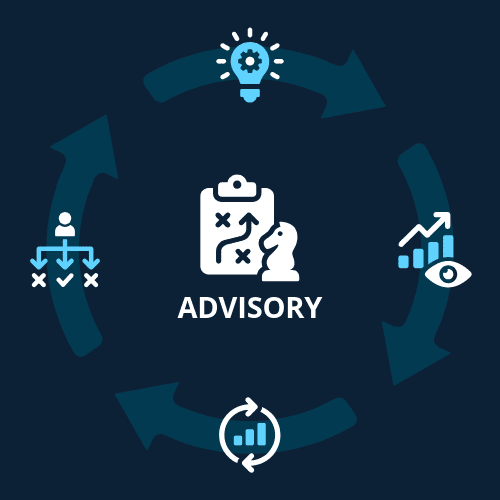

Understand
Review what is driving the discussion, what is already in place, and what constraints may matter.

Evaluate
Compare the available options based on fit, complexity, and how well each supports the goal.
Assess
Consider how each option may affect risk, operations, and the broader environment around it.
Recommend
Move forward with a clear direction that reflects context, tradeoffs, and the intended outcome.
Common Areas

Across security, advisory can help with identity and access, privacy, endpoint security, email security, network security, data protection, backup and recovery, incident response, vulnerability management, logging and monitoring, security awareness, policy development, security planning, phishing protection, patch management, configuration review, access reviews, privileged access, encryption, recovery testing, mobile security, threat detection, device management, security baselines, and more.

Across risk, advisory can help with business exposure, operational exposure, vendor exposure, third-party exposure, customer exposure, compliance exposure, technology exposure, change exposure, implementation failure, control failure, dependency failure, service interruption, business disruption, data loss, recovery gaps, incident fallout, misuse, fraud, liability, reputational impact, decision quality, audit pressure, contract pressure, insurance concerns, and more.

Across technology, advisory can help with platforms, systems, applications, infrastructure, integrations, networks, cloud services, business systems, productivity tools, collaboration tools, data systems, identity platforms, security tools, backup systems, monitoring tools, automation tools, vendor platforms, technical architecture, configurations, environments, documentation, migrations, system changes, tool alignment, service dependencies, implementation support, technical planning, platform oversight, AI, and more.
Common Topics
Conversations can narrow into the topics that need the most attention based on your business needs. This is where guidance becomes more focused, helping bring structure to the discussion and making it easier to work through what matters most.
Strategic
Positioning, Direction, Vision, Goals, Growth, Roadmap, Trajectory, Intent, Advantage, Scale
Risk
Exposure, Threats, Vulnerability, Likelihood, Impact, Consequences, Severity, Tolerance
Tactical
Controls, Dependencies, Coverage, Safeguards, Monitoring, Remediation, Validation, Gaps
Governance
Accountability, Oversight, Structure, Ownership, Decisions, Authority, Escalation, Review
Operational
Processes, Workflows, Support, Maintenance, Execution, Delivery, Continuity, Tasks
Maturity
Capability, Consistency, Stability, Improvement, Evolution, Discipline, Adoption, Baseline
Priorities
Readiness
Preparation, Awareness, Capacity, Resilience, Recovery, Testing, Continuation
Initiatives
Vendors
Providers, Partners, Contracts, Services, Selection, Fit, Renewals, Evaluation, Management
value Gained

Better
Decisions
Clearer
Priorities
Stronger
Direction
Reduced
Rework
Broader
Perspective
Increased
Alignment
Engagement Options
Different situations call for different levels of access, flexibility, and response. ExaQuent offers these options to help you choose the level of engagement that best fits how advisory will be used.

Scheduled Advisory
Hourly
Business Hours
Best for occasional questions, specific topics, or individual decisions that can be planned in advance.

Retainer Advisory
Prepaid
Business Hours + Priority
Best for small businesses that want reserved time, added flexibility, and guidance across multiple discussions.

Ongoing Advisory
Monthly
Extended Hours + Priority
Best for small businesses that want recurring access, priority response, and a more consistent relationship.
Not Every Need Fits Advisory
Advisory is well suited for guidance, direction, and decision support, but some needs require a different kind of engagement. When the work becomes more defined, more hands-on, or more centered on individual leadership development, another path may be a better fit.
Consulting
Structured work with deeper involvement, clearer scope, and defined outcomes to move efforts forward.
Coaching
Focused guidance for those in leadership roles who want ongoing development, perspective, and support.
Get the Guidance You Need
Advisory helps small businesses work through security, risk, and technology decisions with clearer direction, practical perspective, and the right level of engagement. When you are ready to talk through your needs or choose how to get started, the next step is simple.