
Leader Guide | Project Readiness
What Leaders Should Know Before Technology Projects Stall
Technology projects can lose momentum when ownership, decisions, expectations, and follow-through are not clear from the start. This guide helps small business leaders understand what to clarify before important work slows down, drifts, or becomes another unfinished effort.
- ExaQuent-Leader-Guide-What-Leaders-Should-Know-Before-Technology-Projects-Stall00:00
Setting The Context
Projects are often started with good intentions. A business decides it is time to move to a new vendor, replace a system employees depend on, introduce a new tool, change how customer information is handled, improve an internal process, or clean up a recurring problem that has been slowing the business down. The need may be real, the project may be important, and the chosen direction may even be the right one.
The harder part usually begins after the decision is made. People need to understand what is changing, who is responsible for moving the work forward, which decisions still need to be made, and how daily operations will be affected along the way. Without that clarity, the project can appear active while progress is actually slowing.
For small business leaders, project readiness is less about having a formal project management system and more about creating the conditions for progress. The leader does not need to manage every detail personally, but the business does need enough ownership, communication, and follow-through to keep the work from drifting once it begins.
Technology Projects Often Start With The Right Decision.
They Succeed Through Ownership And Follow-Through.
In This Guide
Why Projects Stall
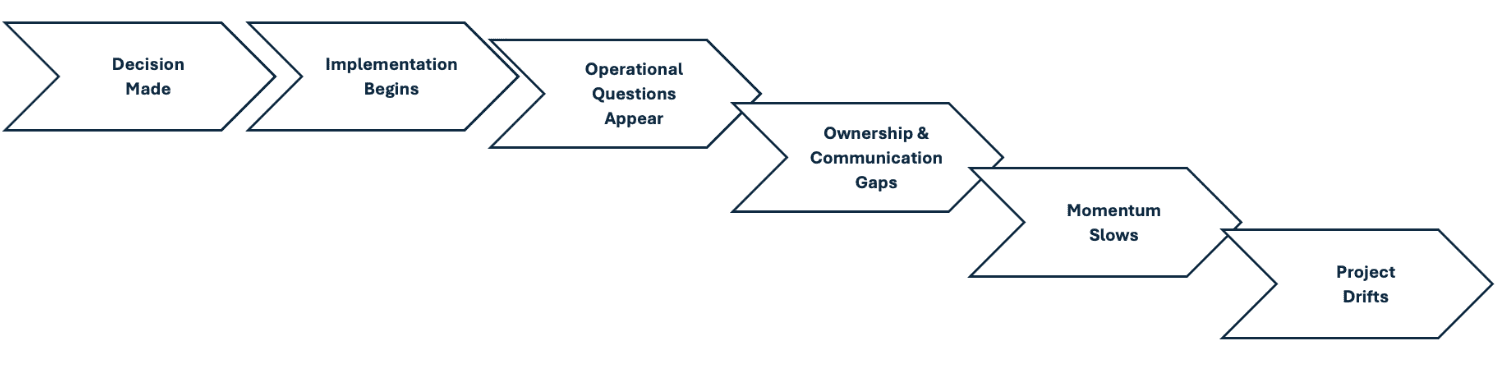
Many projects do not fail because the business made a bad decision. They lose momentum because the work required to support the decision was never fully clarified. A new system may be selected, a vendor may be approved, or a process change may be announced, but the day-to-day coordination needed to move the work forward often remains undefined.
In small businesses, this usually happens quietly. Employees are balancing multiple responsibilities. Leadership attention shifts back toward daily operations. Vendors are waiting on feedback or access. Questions sit unresolved longer than expected. Over time, the project becomes something everyone assumes is still moving, even though meaningful progress has slowed.
This is one reason technology projects can feel deceptively simple at the beginning. The tool itself may only be one part of the effort. The larger challenge is often aligning people, decisions, communication, and operational expectations around the change the business is trying to make.
The Work Is Technical, But The Project Is Operational
Technology projects are often viewed primarily through a technical lens. Leaders may focus on selecting the right platform, replacing outdated systems, improving workflows, or solving a recurring operational frustration. Those decisions matter, but they are usually only the starting point.
Once implementation begins, the project quickly becomes operational. Employees may need to change how they work. Information may need to be reorganized. Processes may shift between departments, vendors, or responsibilities. Decisions that seemed straightforward at the beginning can become more complicated once they interact with daily operations.
For small business leaders, recognizing this transition early can help prevent unnecessary drift. A project that is treated only as a task to complete may struggle once operational questions begin to surface. A project that is treated as a business effort from the start is often better prepared to adapt as the work evolves.
What Leaders Should Clarify Before Work Begins
What Leaders Should Clarify Before Work Begins
Before a project begins, leaders do not need every detail fully mapped out. They do, however, benefit from establishing a few foundational expectations early. Clarifying ownership, communication, decision-making, and operational impact can help reduce confusion once the work is underway.
One important question is ownership. Even when vendors or consultants are heavily involved, someone inside the business still needs responsibility for keeping the project moving. Without clear ownership, tasks and decisions can easily become delayed between employees, leadership, and outside providers.
Communication expectations also matter. Employees do not need constant updates, but they do need enough context to understand what is changing, why the work matters, and how it may affect their responsibilities. Small gaps in communication often become larger operational problems later in the project.
Leaders should also think realistically about timing and operational impact. Technology projects are often planned around ideal timelines, but small businesses still need to manage customer needs, employee workloads, and day-to-day operations while the work is taking place. Recognizing those realities early can help create more sustainable expectations for progress.
What Progress Should Look Like
Progress is not always measured by how quickly a project moves. In many cases, meaningful progress looks like decisions being resolved consistently, responsibilities remaining clear, communication continuing as expected, and operational disruptions being addressed before they grow larger.
Small business leaders do not necessarily need detailed project management systems to support this type of progress. What matters more is maintaining enough visibility to understand where the work stands, what obstacles are slowing momentum, and whether the project still aligns with the business’s original goals.
This visibility becomes especially important once projects move beyond the initial excitement phase. Many efforts begin with strong energy and clear urgency, only to lose attention once implementation becomes routine. Leaders who remain engaged through the operational phase of the work are often better positioned to keep projects moving toward completion.
Turning Clarity Into Follow-Through
Technology projects rarely move in a perfectly straight line. Priorities shift, operational challenges emerge, and decisions sometimes take longer than expected. That does not necessarily mean the project is failing. In many cases, the difference between momentum and drift comes down to whether the business continues creating clarity as the work evolves.
For small business leaders, project readiness is less about formal process and more about maintaining ownership, communication, and operational awareness throughout the effort. A project does not need to be perfect to move forward successfully, but it does need enough structure to keep progress connected to the realities of the business.
When leaders approach technology projects as operational efforts rather than isolated tasks, the work is often better positioned to move beyond implementation and become part of how the business actually operates.

Shawn Skillman
Founder and Principal Advisor
ExaQuent
Looking Beyond The Technology?
Technology projects are only one example of how leadership decisions, communication, and operational realities intersect inside a small business. ExaQuent Coaching provides a place for leaders to explore topics like technology, security, risk, and business operations through practical discussions designed to support informed decision-making and long-term growth.